Final Scrapbook Links

  1. Andrew Miller
  2. In Class Primary Source Analysis, Excerpt from the Berlin Conference General Act.
  3. Blog Post on “How Europe Underdeveloped Africa”Chapters III, IV, & V.
  4. Blog post for 02/25/2020 “How Europe Underdeveloped Africa” Chapter VI.
  5. 02/12/2020 Group Discussion on how “Europe Underdeveloped Africa”
  6. HIS 322 Primary Source Assignment, Native Administration in Nigeria, 02/19/2020
  7. The Wretched of the Earth, Chapters I and II, March 10, 2020
  8. Zulu Movie 03/13/2020
  9. Analysis of Primary Source (Oliver Stanley Speech)
  10. Response to Chapters III & IV of The Wretched of the Earth.
  11. Response to Chapter V & Conclusion of The Wretched of the Earth.
  12. Analysis of Primary Source (Patrice Lumumba’s Speech & Letter to his Wife Pauline)
  13. Group Discussion Notes on How Europe Underdeveloped Africa (02/26)
  14. Response to Dambisa Moyo’s Video Presentation
  15. Final Reflection
  16. Reflection on the The Machete Season

Primary sources

  1. Saso Black Students’ Manifesto
  2. Patrice Lumumba, “Speech at Accra,” 1958
  3. Kwame Nkrumah, I Speak Freedom, 1961
  4. Capt. F. D. Lugard: The Rise of Our East African Empire
  5. “Der schwarze Terror in deutschen Landen,” 1920
  6. “La Moisson de Boudou-Badabou”
  7. J. Keppler, “British benevolence”
  8. “Stowage of the British Slave Ship Brookes”
  9. Zulu Man
  10. “The Negro Worker” 1932

Final Reflection

I thought that the scrapbook helped me realize how unjust these colonial practices were. History 322 has taught me to look at the effects in which colonialism has left on the people of Africa. All three of the books that were assigned taught me why Africa has been struggling for years. It is not because the people of Africa have created a system where it is hard to overcome poverty, it was the colonization of the continent. These colonizers created a system in which only Europeans would succeed. This was my first African History course since high school, and my perceptive on Africa as changed. I knew Europe was one of the main reasons as to why Africa was underdeveloped, however, not to the extent in which I have learned in this class.

The third book we read; Machete Season was probably the best book I have read at SUNY Cortland. I say this because the Rwanda Genocide is not talked about as significantly as other genocides such as the Holocaust. The testimonies and interviews of these killers put the genocide into perspective. Some of these individuals had to kill their neighbors so that their family members could survive. To think of killing my neighbor so that my family and I could survive baffled me. It was extremely in-depth and showed me how even 30 years after colonialism, conflicts, and problems arise because of it. 

There was so much other information such as the suppression of rights to the Africans. I knew that they were used as slaves, but not in their own country by colonizers. I found that dreadful to think about because these people did not deserve to be enslaved and then work around the places in which they were free years or months before. I also disliked how the Europeans tried to assimilate Africans into Europeans by teaching them European history and neglecting African cultures. It disgusted me when Dr. Bekeh described how students would be beaten and hit if they did not go to school. Or the fact that their name would be put on a blacklist if they did something that did not fit European cultures.

The movie Zulu, piqued my interest because it showed how Europeans, specifically the British, tried implementing their ways upon native Africans. It was interesting to note that Zulu soldiers did not kill the British when they surrendered. I think that’s why in the picture of the Zulu man, it showed a halo over his head. They understood that death was not the answer, and these people still deserved to live. Also, it showed the cultural aspects of Africa, people working together as one, to defeat a common conflict. This can be seen when African countries start to overthrow their colonizers. 

Lastly, I am happy that I took History 322 because it is going to help me as a teacher show my students how detrimental and uncivil Europeans were to Africans. Although Africa is not a major topic in Global History in New York, I will find ways to include it. It is important that students do no leave high school like me, and I can help spread the narrative of how detrimental colonialism was. 

Zulu Man

https://www.si.edu/object/zulu-man:saam_1985.66.165_706

The image above shows a Zulu man and comes from the Smithsonian Institute. It was created by Antonion Zeno Shindler in 1813. This man is a soldier of the society and the interesting thing about this image is that it looks like he has a halo above his head. This painting was made in Bulgaria, and this depiction shows that he is holy. The interpretation can be taken in many directions; however, the artist could feel as if the Zulu are the ones who are right and good, while the British imperialists are bad and selfish. This image relates to the Zulu movie we watched in class and at home. Just like the movie showed the British should not have been trying to colonize Africa. The societies in Africa had been functioning for thousands of years, so by trying to instill new values and colonize them was unjust. The halo above the Zulu man’s head showed who the holy groups were in these conflicts. 

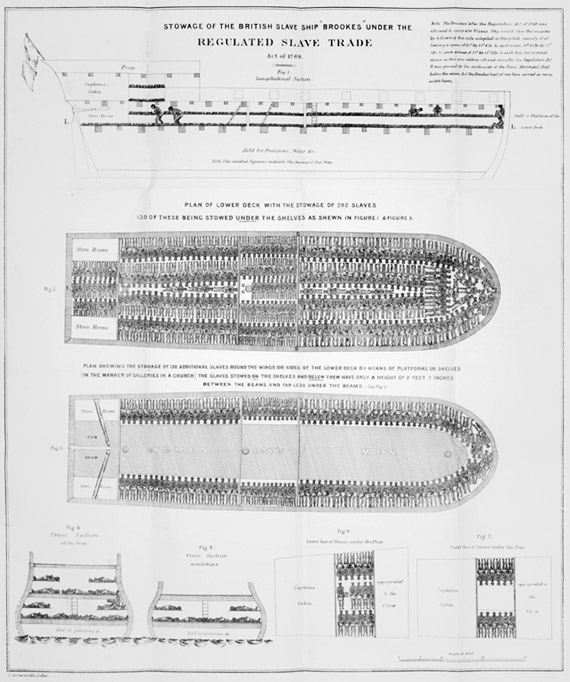
“Stowage of the British Slave Ship Brookes”

https://rmc.library.cornell.edu/abolitionism/origins/Slave_Ships_pic1.htm

The diagram above was created in 1851 and shows what a Liverpool slave ship looked like. As the picture shows, it can hold nearly a hundred African slaves. First, these conditions are vile and show how cramped and inhumane they were. The diagram above shows that slaves had to duck just to walk and that there were two levels in which tens of hundreds of people were transported. One positive of this document found in Samuel J. May’s description is that it was used in Thomas Clarkson’s evidence to Parliament as an argument to banish the slave trade. This source relates to our class because it shows how European powers were stealing and enslaving people. Men and women are needed in a society to grow strong, however, due to the slave trade, Africa did not have these people to rebel against colonizers and help society grow.

J. Keppler, “British benevolence”

https://www.loc.gov/resource/ppmsca.28494/

J. Keppler’s image of the fat British Lion is propaganda to show how strong and powerful their armies were. Also, he shows the victims of imperialism that had fallen to the British empire. For example, the Ashanti and Zulu societies to the left showing that they have been defeated. It shows how colonialism has spread, and that whatever nation in Africa that had not been colonized will be targeted by these powers. This image relates to the class because it shows how European powers were not satisfied once they colonized a country or region. Also, the title claims that the British were being kind, and meant well while taking over the country. This relates to our class because, for the European point of view, they were “helping” Africans. However, they were not helping them, they were extracting their resources, leaving detriment to a continent. 

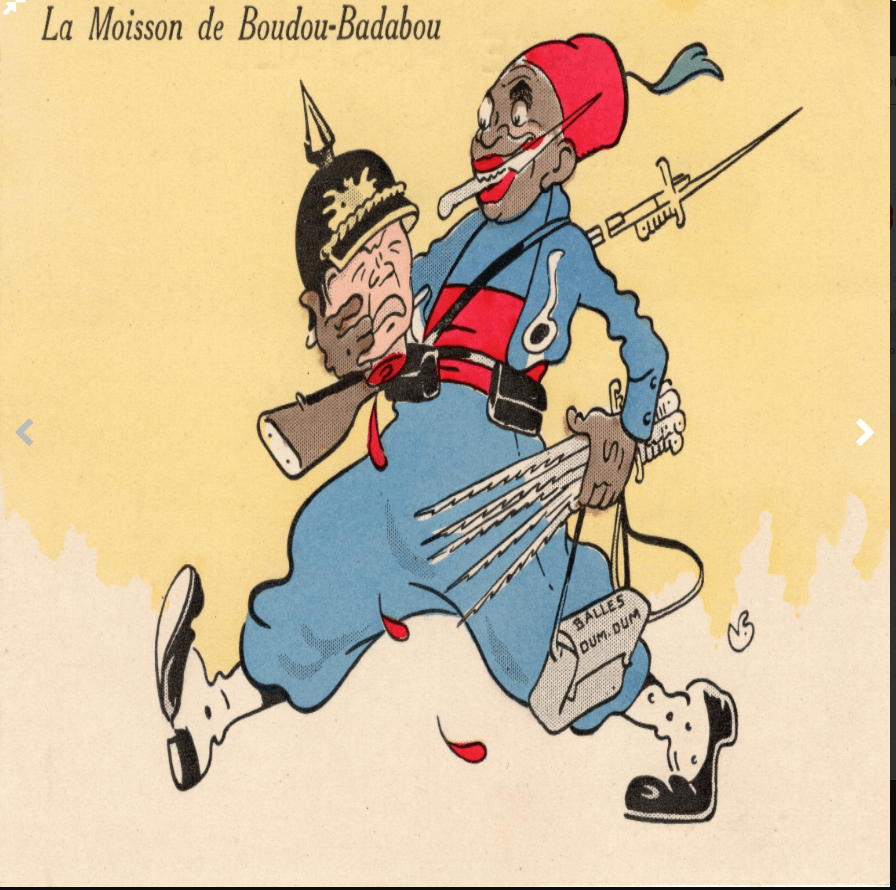
“La Moisson de Boudou-Badabou”

The postcard of “La Moisson de Boudou-Badabou” depicts Africans as murderous and savage individuals. It was developed in 1914/1915 around the times of World War One. The French are trying to justify their imperialism by using propaganda to negatively depict Africans. The image also shows them carrying Balles Dum – Dum which was banned in the rules of war. This topic relates to the primary source we read about Stanley trying to justify why colonization was good. For example, this image shows that these Africans are savage, and need to be taught the ways of society by a European country. However, that interpretation can be tarnished since the Africans have gone through oppression and racism throughout the last two centuries. The idea of Africans fighting for independence is the reason why they would rebel and fight in a war.

“Der schwarze Terror in deutschen Landen,” 1920

https://digi.ub.uni-heidelberg.de/diglit/kla1920/0317/image

The cartoon above from a German newspaper depicts Africans as gorillas. First, this is extremely racist because Africans are humans, who should not be depicted as animals. Then, Tthe translation of the title states “The black terror in German Lands” which is ironic because the Germans have colonized their lands. This document related to this class because it shows how colonizers tried justifying the colonization of Africa. By showing the German people and the world how savage Africans were, it creates an incentive that they need European education. Having the support of other countries helped Germany, France, Belgium, and Great Britain justify their inhumane practices and rule over Africa. 

“The Negro Worker” 1932

https://collections.si.edu/search/record/edanmdm:nmaahc_2010.55.6

“The Negro Worker” book is to promote emancipation. This book comes from the Smithsonian Institute. This is the back of the book and the last thing in which an African would read. It states that these pamphlets are free and that there is no reason why the people of Africa should be following orders from a foreign country. The back image is very powerful because it shows a black man breaking the chain over Africa, This shows that Africa cannot be chained up, and hidden from the world. This book was made so Africans would start to fight for freedom. This source relates to the lesson about “Paths to Independence” because it shows the activism to conjoin as one country or nation. The entire pamphlet shows the injustices as well as why Africans need to rebel and start to fight for their independence. 

Capt. F. D. Lugard: The Rise of Our East African Empire

“One word as regards missionaries themselves. The essential point in dealing with Africans is to establish a respect for the European. Upon this—the prestige of the white man—depends his influence, often his very existence, in Africa. If he shows by his surroundings, by his assumption of superiority, that he is far above the native, he will be respected, and his influence will be proportionate to the superiority he assumes and bears out by his higher accomplishments and mode of life. In my opinion—at any rate with reference to Africa—it is the greatest possible mistake to suppose that a European can acquire a greater influence by adopting the mode of life of the natives. In effect, it is to lower himself to their plane, instead of elevating them to his. The sacrifice involved is wholly unappreciated, and the motive would be held by the savage to be poverty and lack of social status in his own country. The whole influence of the European in Africa is gained by this assertion of a superiority which commands the respect and excites the emulation of the savage. To forego this vantage ground is to lose influence for good. I may add, that the loss of prestige consequent on what I should term the humiliation of the European affects not merely the missionary himself, but is subversive of all efforts for secular administration, and may even invite insult, which may lead to disaster and bloodshed. To maintain it a missionary must, above all things, be a gentleman; for no one is more quick to recognize a real gentleman than the African savage. He must at all times assert himself, and repel an insolent familiarity, which is a thing entirely apart from friendship born of respect and affection. His dwelling house should be as superior to those of the natives as he is himself superior to them. And this, while adding to his prestige and influence, will simultaneously promote his own health and energy, and so save money spent on invalidings to England, and replacements due to sickness or death…..

I am convinced that the indiscriminate application of such precepts as those contained in the words to turn the other cheek also to the smiter, and to be the servant of all men, is to wholly misunderstand and misapply the teaching of Christ. The African holds the position of a late-born child in the family of nations, and must as yet be schooled in the discipline of the nursery. He is neither the intelligent ideal crying out for instruction, and capable of appreciating the subtle beauties of Christian forbearance and self-sacrifice, which some well-meaning missionary literature would lead us to suppose, nor yet, on the other hand, is he universally a rampant cannibal, predestined by Providence to the yoke of the slave, and fitted for nothing better, as I have elsewhere seen him depicted. I hold rather with Longfellow’s beautiful lines”

https://sourcebooks.fordham.edu/mod/1893lugard.asp

In Captain F. D. Lugard’s explanation of colonization, he states how these people need Europeans because of their wisdom. His passage goes on for many paragraphs, however, the one I decided to include shows the oppression in which Africans were dealing with. He states that Africans need the white men, to exist, however, that the approach of the white men had been poor. He states that Europeans should have adopted African ways of life, rather than trying to go up to the level of theirs. Although his points are much less radical than the leaders of the colonizers, he still described Africans as savages, who need to learn the European way. This document compares to colonial development. Lugard explained how colonialism will work, which is thought colonial policy that is less strict than the ones being implemented.
Kwame Nkrumah, I Speak Freedom, 1961

“For centuries, Europeans dominated the African continent. The white man arrogated to
himself the right to rule and to be obeyed by the non-white; his mission, he claimed, was to“civilise” Africa. Under this cloak, the Europeans robbed the continent of vast riches and inflicted unimaginable suffering on the African people.
All this makes a sad story, but now we must be prepared to bury the past with its unpleasant memories and look to the future. All we ask of the former colonial powers is their goodwill and cooperation to remedy past mistakes and injustices and to grant independence to the colonies in Africa?
It is clear that we must find an African solution to our problems, and that this can only be found in African unity. Divided we are weak; united, Africa could become one of the greatest forces for good in the world.
Although most Africans are poor, our continent is potentially extremely rich. Our mineral
resources, which are being exploited with foreign capital only to enrich foreign investors, range from gold and diamonds to uranium and petroleum. Our forests contain some of the finest woods to be grown anywhere. Our cash crops include cocoa, coffee, rubber, tobacco and cotton. As for power, which is an important factor in any economic development, Africa contains over 40% of the potential water power of the world, as compared with about 10% in Europe and 13% in North America. Yet so far, less than 1% has been developed. This is one of the reasons why we have in Africa the paradox of poverty in the midst of plenty, and scarcity in the midst of abundance.
Never before have a people had within their grasp so great an opportunity for developing a continent endowed with so much wealth. Individually, the independent states of Africa, some of them potentially rich, others poor, can do little for their people. Together, by mutual help, they can achieve much. But the economic development of the continent must be planned and pursued as a whole. A loose confederation designed only for economic co-operation would not provide the necessary unity of purpose. Only a strong political union can bring about full and effective development of our natural resources for the benefit of our people.”

https://sourcebooks.fordham.edu/mod/1961nkrumah.asp

Kwame Nkrumah would go onto be the first president of Ghana in 963, however, this speech explains the injustices in which Europeans did. The quotation above is the introduction section of his speech. He states that for centuries the white men robbed the continent of its vast riches. This speech relates to the book we read. In Walter Rodney’s book How Europe Undeveloped Africa, he explains the injustices that occurred due to the exploitation of Europeans as they entered the African continent. His speech is inspiring because he states that even though they had to experience these tragedies and look to an independent African future. The only assistance in which he asks Europe for is the independence of all African countries. This is a powerful statement explaining that he does not want reparations, just for a free Africa.

Design a site like this with WordPress.com
Get started